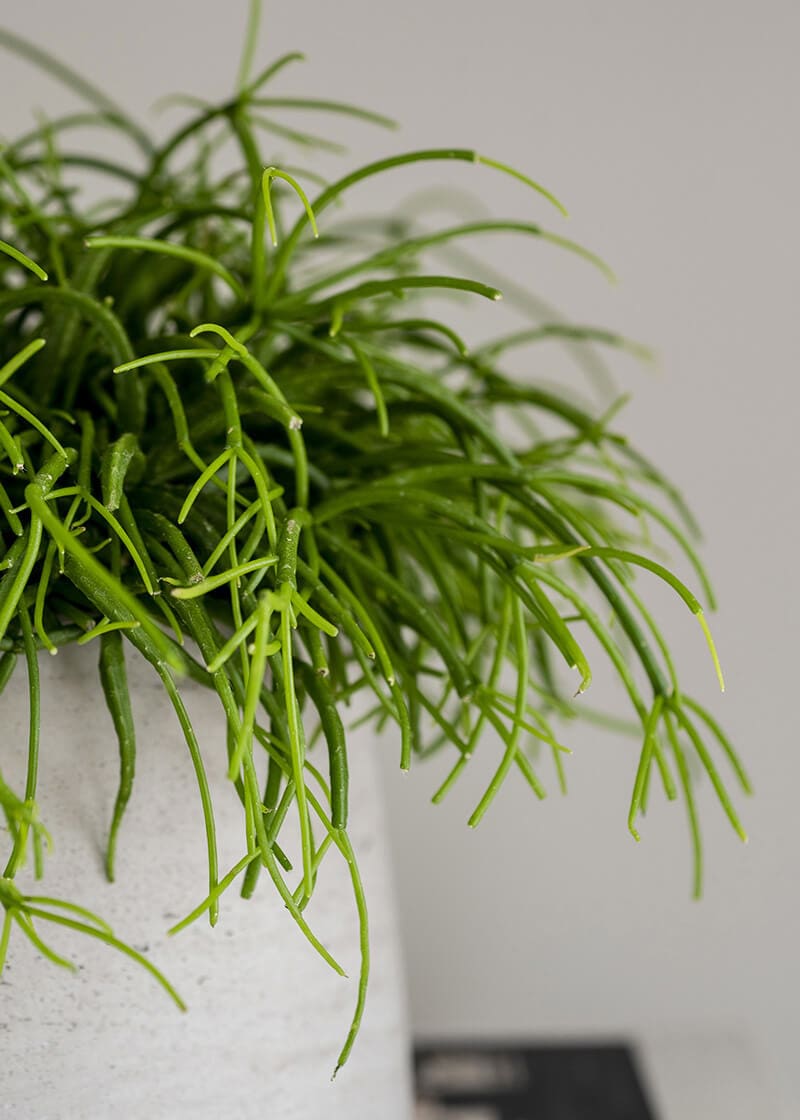
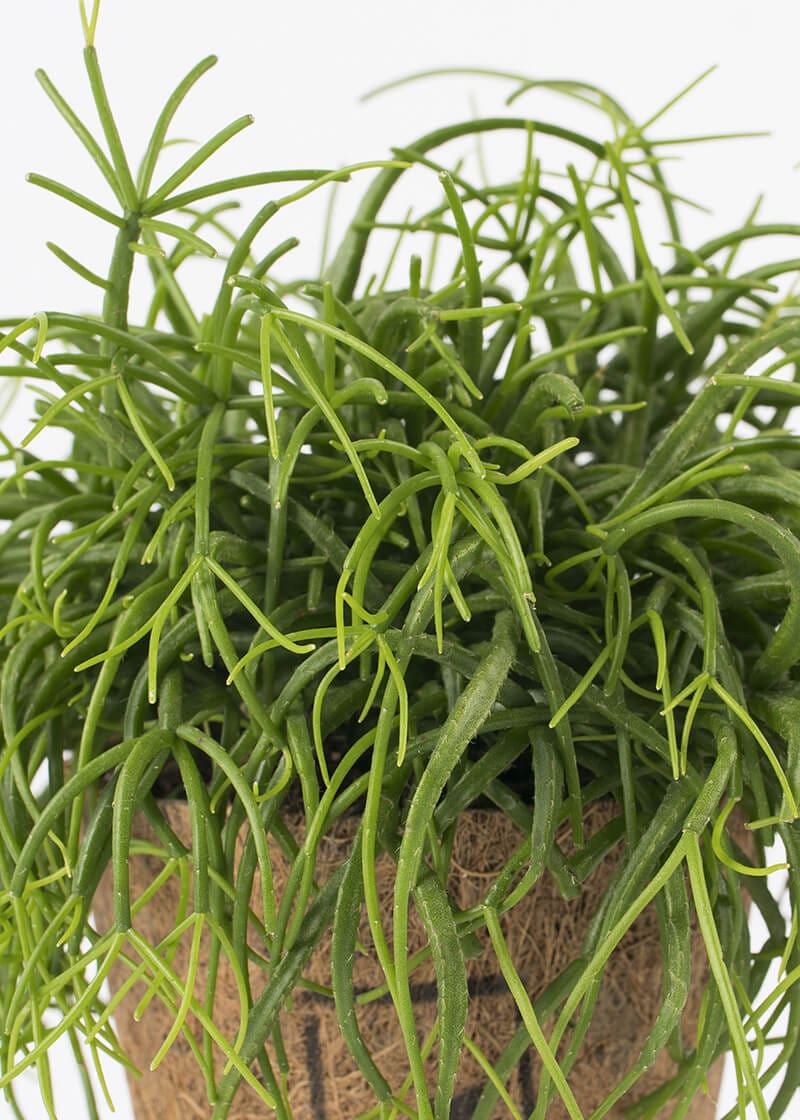
Mistletoe Cactus, or Rhipsalis baccifera, is a unique houseplant with trailing succulent-like stems, making this a great hanging plant.
Latin name Rhipsalis baccifera (Trailing)
Pronunciation (“rip-SAH-liss bak-SIFF-eh-rah”)
Common name Rhipsalis baccifera
Origin Probably originally from Columbia, but is found all over South and Central America, the Caribbean and Tropical Africa
Most people imagine cacti to be large, spiny, desert-dwelling plants. However there is a group of cactus species that come from the humid tropical forests, and they look very different from their desert-dwelling relatives. They are epiphytes (in other words they live among the branches of trees) and they need to get all of the nutrients and water from the air or that which gets trapped in amongst the branches and leaves of the trees.
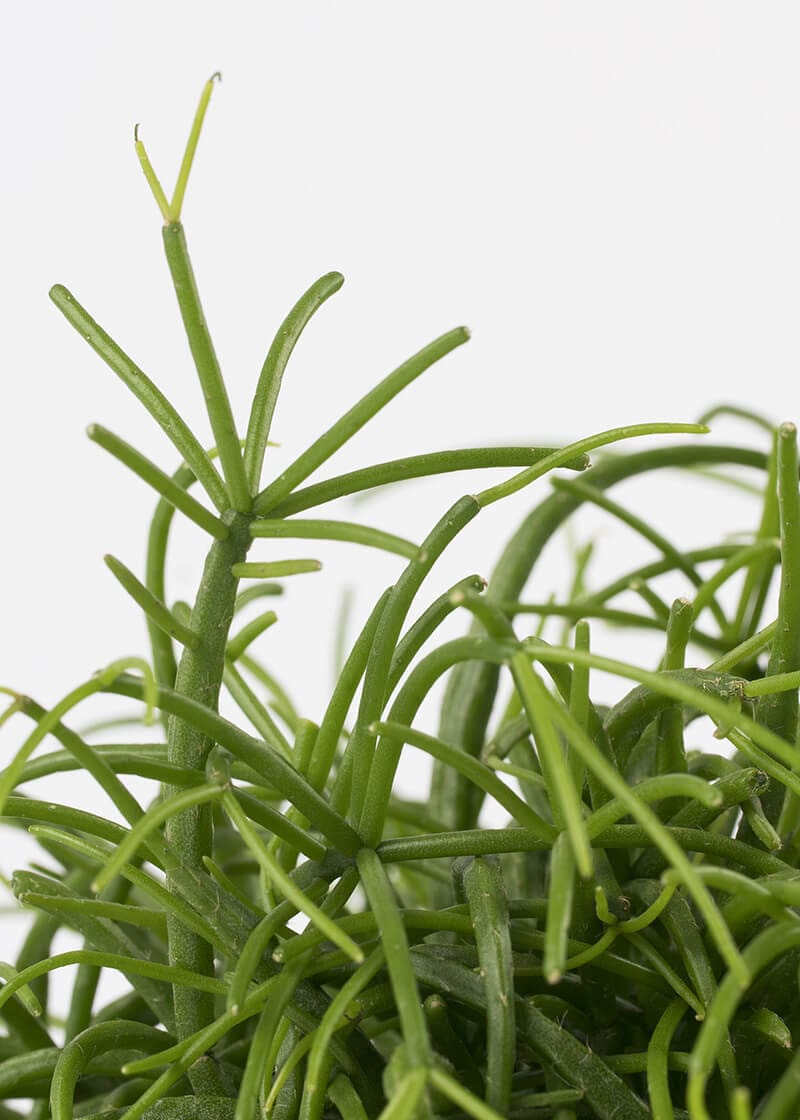
Rhipsalis baccifera is one of the mistletoe cacti. It has long, slender jointed, branched cylindrical and generally smooth stems that hang down in long spidery clusters. Like all cacti, it has no leaves and photosynthesis occurs in the fleshy, semi-succulent stems, which occasionally produce adventitious roots . At the end of the stems, small, fairly insignificant flowers grow, leading eventually to small white (or pinkish white) berries that resemble those found on mistletoe (hence its popular name).
As a species it is quite variable, and it is one of only a very few species of cactus that is found naturally beyond the Americas – it is thought that seeds from the plant may have been carried by migrating birds to Africa and beyond, or even on the ships of early explorers.
Did you know?
The first specimen was brought to England by Mr Philip Miller in 1758, which he brought from the Caribbean.
Non-toxic to pets and humans, making it a safe and stylish addition to any home or office.
caring for your plant
Light
Medium to high light. Avoid prolonged exposure to direct sunlight.
Watering
Keep soil moist and occasionally mist the foliage with tepid water.
Pruning
The plant can be kept compact by trimming the stems where there is a natural joint – at which point, new growth will appear as a forked stem.
Feeding
A weak solution of fertilizer can be added to the water at every watering. If the plant gets stressed or is deficient in nutrients, the stems can turn a reddish colour.
pest & diseases
Occasional mealybugs, which can be picked off when you see them.
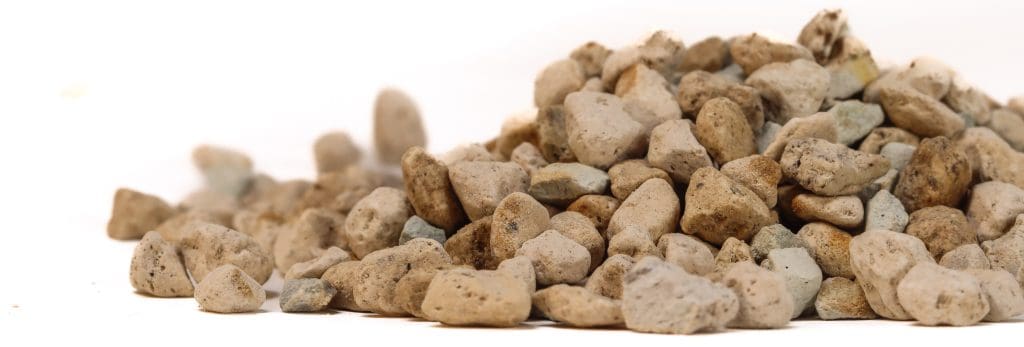
Our plants are grown in Ecoponic, an alternative to soil. Officially known as a vulkaponic substrate, it replaces traditional compost with a clean, mineral-based medium that helps protect peatlands.
According to the IUCN UK Peatland Programme, “A loss of only 5% of UK peatland carbon would be equal to the UK’s annual greenhouse gas emissions.” As well as storing carbon, the natural wetlands where peat is found are critical to the survival of plants and wildlife. Ecoponic also improves plant health and uses water more efficiently.
Research from the University of Exeter found that offices with plants can increase productivity by up to 15% while also improving concentration and job satisfaction.
Plantopedia is brought to you as part of our Engage & Bloom workplace experience program.
explore more
Why not continue your journey through the plant world. Explore more plants, their stories, habitats and the benefits they bring to spaces.
To provide the best experiences, we use technologies like cookies to store and/or access device information. Consenting to these technologies will allow us to process data such as browsing behaviour or unique IDs on this site.
Functional
Always active
The technical storage or access is strictly necessary for the legitimate purpose of enabling the use of a specific service explicitly requested by the subscriber or user, or for the sole purpose of carrying out the transmission of a communication over an electronic communications network.
Preferences
The technical storage or access is necessary for the legitimate purpose of storing preferences that are not requested by the subscriber or user.
Statistics
The technical storage or access that is used exclusively for statistical purposes.The technical storage or access that is used exclusively for anonymous statistical purposes. Without a subpoena, voluntary compliance on the part of your Internet Service Provider, or additional records from a third party, information stored or retrieved for this purpose alone cannot usually be used to identify you.
Marketing
The technical storage or access is required to create user profiles to send advertising, or to track the user on a website or across several websites for similar marketing purposes.